Enrichment & classification
Discovery returns many motifs. The two steps below tell you where each one sits relative to the binding site, and which known factor it corresponds to.
Motif enrichment and positional distribution
KDMMap performs the positional enrichment analysis, comparing bound against unbound
sequences within a sliding window:
Function: KDMMap
| Parameter | Meaning |
|---|---|
motifs | a kdmotifs object obtained from KDMFind |
pseq | array of sequences: a set of equal length bound sequences |
nseq | array of sequences: a set of equal length unbound sequences (sequence length must be the same as pseq) |
halfWin | integer: defines the sliding window size (actual window size is 2*halfWin+1) used to calculate the signal along the provided sequences |
sig.level | the significance level at which a motif is considered centrally enriched (default: 0.05) |
experiment.type | string: either "ChIP" or "Clip", used to define the regions along the sequences which are considered "central" (default "ChIP") |
| Output | a list containing two elements: results, a data frame with the motifs identified as both centrally distributed and enriched in the bound sequences; and profiles, a list containing signal and hits along the sequences for each motif, used for plotting purposes (see plot.motif.map) |
For each sequence, KDMMap slides a window, scores the motif in every window and
keeps the maximum-scoring position. A score threshold chosen to maximise
classification accuracy between bound and unbound sequences decides which of those maxima count as
hits, so each sequence contributes at most one hit.
On the motifs obtained in the previous step and the bound and unbound sequences of our dataset:
centrality<-KDMMap(motifs=motifs,pseq=NRF1$train$pseq,nseq=NRF1$train$nseq,halfWin=15)The first element of the output contains a data frame with the motifs which resulted centrally enriched:
centrality$results motif Start End bin_location PE CE motif_auroc PE_p.value PE_q.value CE_p.value CE_q.value np_in np_out nn_in nn_out
18455 M-105 -40 40 0 2.652382 90.250000 0.983796 9.388931e-106 1.267506e-103 0.000000e+00 0.000000e+00 361 91 4 9
17691 M-59 -38 38 0 2.615022 25.600000 0.841544 7.069717e-70 1.875921e-68 8.632840e-289 6.474630e-288 256 86 10 33
180751 M-92 -39 39 0 2.583608 32.500000 0.766384 2.325509e-53 1.569719e-51 4.258871e-233 2.613398e-232 195 62 6 16
26375 M-67 -64 64 0 1.653126 16.066667 0.805500 2.830310e-29 9.097424e-29 3.173155e-222 2.519859e-221 241 63 15 22
17303 M-121 -37 37 0 2.043038 10.000000 0.806176 2.787635e-27 3.763307e-25 3.362378e-125 6.877591e-125 180 136 18 61
28995 M-57 -74 74 0 1.444295 5.000000 0.809280 3.713062e-22 1.193484e-21 9.553374e-131 4.447260e-130 280 70 56 43
20295 M-98 -45 45 0 1.981893 7.375000 0.715312 3.960973e-28 5.347314e-26 2.593876e-101 2.059843e-100 177 87 24 65
22371 M-122 -51 51 0 1.535141 4.725490 0.821372 4.002203e-17 4.502478e-16 8.999370e-103 2.825384e-102 241 169 51 113
20651 M-53 -46 46 0 1.735484 4.772727 0.766004 2.912104e-22 3.573945e-21 1.210498e-87 1.907666e-86 210 140 44 111
28251 M-77 -71 71 0 1.380198 3.865672 0.791848 5.221001e-15 2.135864e-14 7.175777e-93 1.405411e-91 259 94 67 67
16515 M-1 -35 35 0 1.742592 4.558824 0.747740 9.129409e-15 6.616866e-13 3.852132e-59 1.368521e-58 155 182 34 114
18075 M-15 -39 39 0 1.592845 4.073171 0.742032 3.087111e-12 8.416485e-11 1.632904e-57 4.322393e-57 167 190 41 131
22035 M-5 -50 50 0 1.344868 2.756757 0.722620 8.038073e-08 8.347230e-07 4.429307e-45 8.542236e-45 204 200 74 132
27203 M-95 -67 67 0 1.270818 2.821918 0.723272 5.873790e-07 2.832006e-06 3.303985e-47 1.205508e-46 206 117 73 81
220351 M-26 -50 50 0 1.506649 2.719298 0.680516 1.349700e-10 1.656450e-09 7.107858e-32 1.573051e-31 155 119 57 95
14055 M-70 -29 29 0 1.560351 3.000000 0.737544 7.270253e-09 6.404828e-07 5.197548e-33 8.158942e-33 141 271 47 171
13631 M-13 -28 28 0 1.651754 3.027027 0.629112 9.001952e-09 6.076318e-07 4.726331e-26 1.595137e-24 112 208 37 171
25511 M-17 -61 61 0 1.238490 2.562500 0.725428 2.036558e-05 1.255477e-04 1.521125e-40 2.976113e-40 205 157 80 107
26091 M-38 -63 63 0 1.261607 2.595238 0.759484 1.415064e-06 1.289711e-04 1.022365e-44 2.706261e-44 218 148 84 76
14891 M-83 -31 31 0 1.686179 3.263158 0.528352 5.293780e-06 8.627250e-05 6.911120e-16 4.541193e-14 62 95 19 92
12771 M-6 -26 26 0 1.805369 2.944444 0.531032 4.537321e-06 1.566227e-04 4.996895e-12 2.872774e-11 53 96 18 80The columns of centrality$results:
| Column | Meaning |
|---|---|
motif | name of the motif |
Start, End | the boundaries of the region in which the motif shows higher values of PE and CE |
bin_location | the center of the region |
PE | Positional Enrichment: the fraction of bound-sequence hits that fall inside the region, divided by the fraction expected under a uniform positional distribution — PE = (Hr,pos / Hs,pos) / p0, with p0 = Lr / Ls, the region length over the sequence length |
CE | Class Enrichment: the fraction of bound sequences with a hit in the region, divided by the same fraction in the unbound sequences — CE = (Hr,pos / Npos) / p0, with p0 = Hr,neg / Nneg, where Npos and Nneg are the numbers of bound and unbound sequences |
motif_auroc | the AUROC of the motif's maximum score per sequence, discriminating bound from unbound sequences. It is reported as -(1 - AUROC) when the motif scores higher in the unbound sequences, so its absolute value is always ≥ 0.5 and its sign gives the direction |
PE_p.value, PE_q.value | significance of PE: an upper-tail binomial test p-value, and its multiple-testing-corrected q-value |
CE_p.value, CE_q.value | significance of CE: an upper-tail binomial test p-value with Hr,pos successes out of Npos trials, and its multiple-testing-corrected q-value |
np_in, np_out | number of hits inside and outside the region for bound sequences: np_in is Hr,pos, and np_in + np_out is Hs,pos |
nn_in, nn_out | number of hits inside and outside the region for unbound sequences: nn_in is Hr,neg |
PEandCEare as defined in the manuscript (Eq. 14-15).
Centrality profiles
The second element contains the scores and the number of hits for all the motifs along all the sequences: it can be used to visualize the centrality profiles as follows, for the most enriched motif:
plot.motif.map(centrality,"M-105")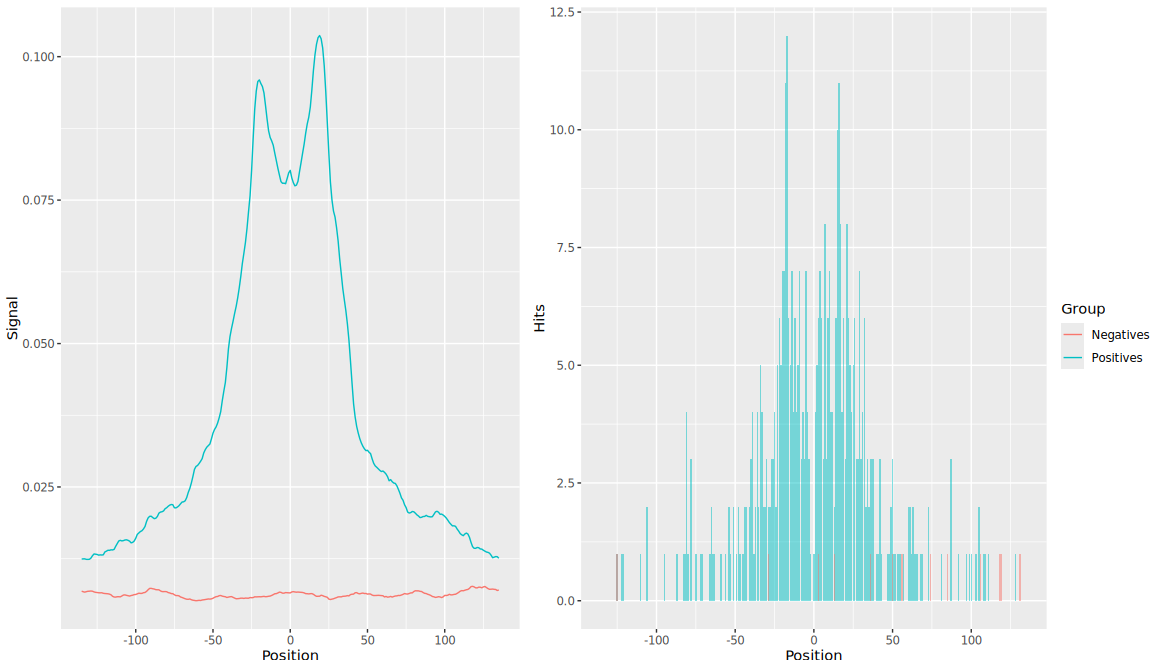
M-105 is centrally enriched: both signal and hits concentrate around the peak summit in the bound sequences, while the unbound ones stay flat.And, for a motif which is not central but is still enriched with respect to the unbound sequences:
plot.motif.map(centrality,"M-19")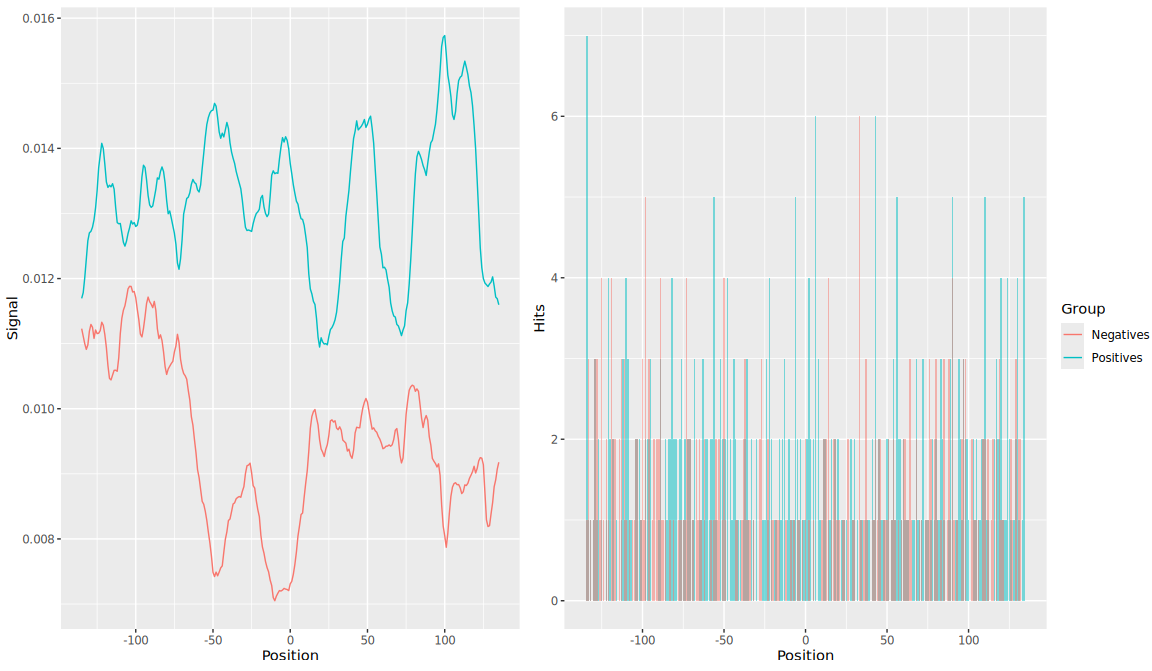
M-19 is enriched but not central: the bound sequences carry more signal than the unbound ones everywhere, with no concentration at the summit.Motifs classification
KDMMatch annotates the discovered motifs by information-content-aware matching
against a reference set already embedded in KDM space:
Function: KDMMatch
| Parameter | Meaning |
|---|---|
query.motifs | a kdmotifs object obtained from KDMFind containing the motifs we want to classify |
target.motifs | a kdmotifs object containing the motifs against which we want to classify the query |
target.parameters | an object obtained through the helper function buildKDMReference which contains parameters for the linear models used to correct for target motifs IC content |
best.hit | logical: if TRUE the function reports the best hit for each query motif. Otherwise the function reports all the matches for each motif |
threshold | the significance level at which matches are reported (default: 0.05) |
| Output | a data frame containing the matching info |
The columns of that data frame:
| Column | Meaning |
|---|---|
query | the name of the query motif |
target | the name of the matching target motif |
p.value | the p-value for the matching |
q.value | the Bonferroni corrected p-value (depends on the number of target motifs) |
similarity | the similarity between the query and target motifs |
rank | for each query motif, the similarity rank with the targets (1 the most similar; if best.hit=TRUE this is always 1) |
Building a reference
To classify our motifs we need an annotated reference collection of KDM. To build such a
collection the helper function buildKDMReference can be used:
Function: buildKDMReference
| Parameter | Meaning |
|---|---|
motifs | either a meme file name (see the MEME motif format) containing PWMs definitions, or an object of class kdmotifs |
info | a data frame with the number of rows corresponding to the number of motifs. It must contain a name column with the names to assign to the motifs. It can contain other columns of your choice (i.e. the protein to which each motif is associated, or the experiment the motif comes from). If left unassigned the motif names will be REF-1, REF-2 and so on |
dictionary | the dictionary used to transform PWMs into KDMs |
| Output | a list containing motifs, the kdmotifs object representing the motifs; info, the passed info data frame; and parameters, an object which contains parameters for the linear models used to correct for target motifs IC content |
For instance we can produce a reference for the HOCOMOCO v13 in vivo motifs collection as follows:
PWMREF<-buildKDMReference("H13INVIVO_meme_format.meme",dictionary=dictionaryTF)In this example though, we use the reference we assembled for the paper from the ENCODE
experiments. It can be loaded from the TF_ENCODE_KDM_REF.Rdata file in the examples
folder:
load("TF_ENCODE_KDM_REF.Rdata")Now we can classify the motifs we obtained before with:
classification<-KDMMatch(query.motifs=motifs,target.motifs=TF_ENCODE_KDM_REF$motifs,best.hit=TRUE,target.parameters=TF_ENCODE_KDM_REF$parameters,threshold=0.05)obtaining:
head(classification) query target p.value q.value similarity rank
1 M-1 TF_REF_03129 6.935578e-61 4.427673e-57 0.4082271 1
2 M-2 TF_REF_02873 3.535196e-05 1.504579e-02 0.2306516 1
3 M-3 TF_REF_05828 1.021659e-113 6.522269e-110 0.7008772 1
4 M-4 TF_REF_05436 2.420400e-20 1.545183e-16 0.4073220 1
5 M-5 TF_REF_00166 3.785907e-83 2.416923e-79 0.6171039 1
6 M-6 TF_REF_01372 5.509329e-09 1.172385e-05 0.2199218 1
. . .It is possible to match the obtained target motifs to the corresponding information:
head(TF_ENCODE_KDM_REF$info[match(classification$target,TF_ENCODE_KDM_REF$info$name),]) name target cell experiment
3129 TF_REF_03129 NRF1 HepG2 ENCSR853ADA
2873 TF_REF_02873 KDM4B HepG2 ENCSR280SCF
5828 TF_REF_05828 MAZ MCF-7 ENCSR288IJC
5436 TF_REF_05436 ZNF319 K562 ENCSR231PDA
166 TF_REF_00166 E2F6 A549 ENCSR000BTC
1372 TF_REF_01372 NRF1 H1 ENCSR000ECC